
Crabs, oysters and the table · Chesapeake Bay
Oysters and the watermen
The oyster built the Eastern Shore's harbor towns, then nearly vanished from the bay. Today wild harvest, sanctuary reefs and oyster farms share the water, and the season still starts when it turns cold.
For most of the nineteenth century, the Chesapeake Bay produced more oysters than anywhere else in the world. Boats crowded the Shore's rivers every winter, packing houses lined the harbors, and rail lines carried barrels of oysters and cans of shucked meat to cities across the country. Whole towns on the Eastern Shore grew up around the trade. Then, over the course of a century, most of the oysters disappeared. The story of how that happened, and what the bay is doing about it, explains a great deal about the Shore today.
The oyster boom
The Eastern oyster builds reefs. Generation after generation, young oysters settle on the shells of older ones, and over centuries the reefs in the Chesapeake grew so large that early colonists described them as a navigation hazard. The oysters also filtered the water, and the reefs sheltered fish, crabs and countless smaller animals.
The harvest expanded rapidly after the Civil War. Railroads and canning made it possible to ship oysters far inland, and the catch in Maryland rose to millions of bushels a year by the late nineteenth century. Competition for the best beds grew fierce. Boats from other states arrived to dredge Maryland's waters, watermen who worked by hand fought those who dredged, and Maryland and Virginia clashed over boundary waters. The state created a police force on the water to keep order, and the confrontations of those decades are remembered as the oyster wars.
Tongs, dredges and skipjacks
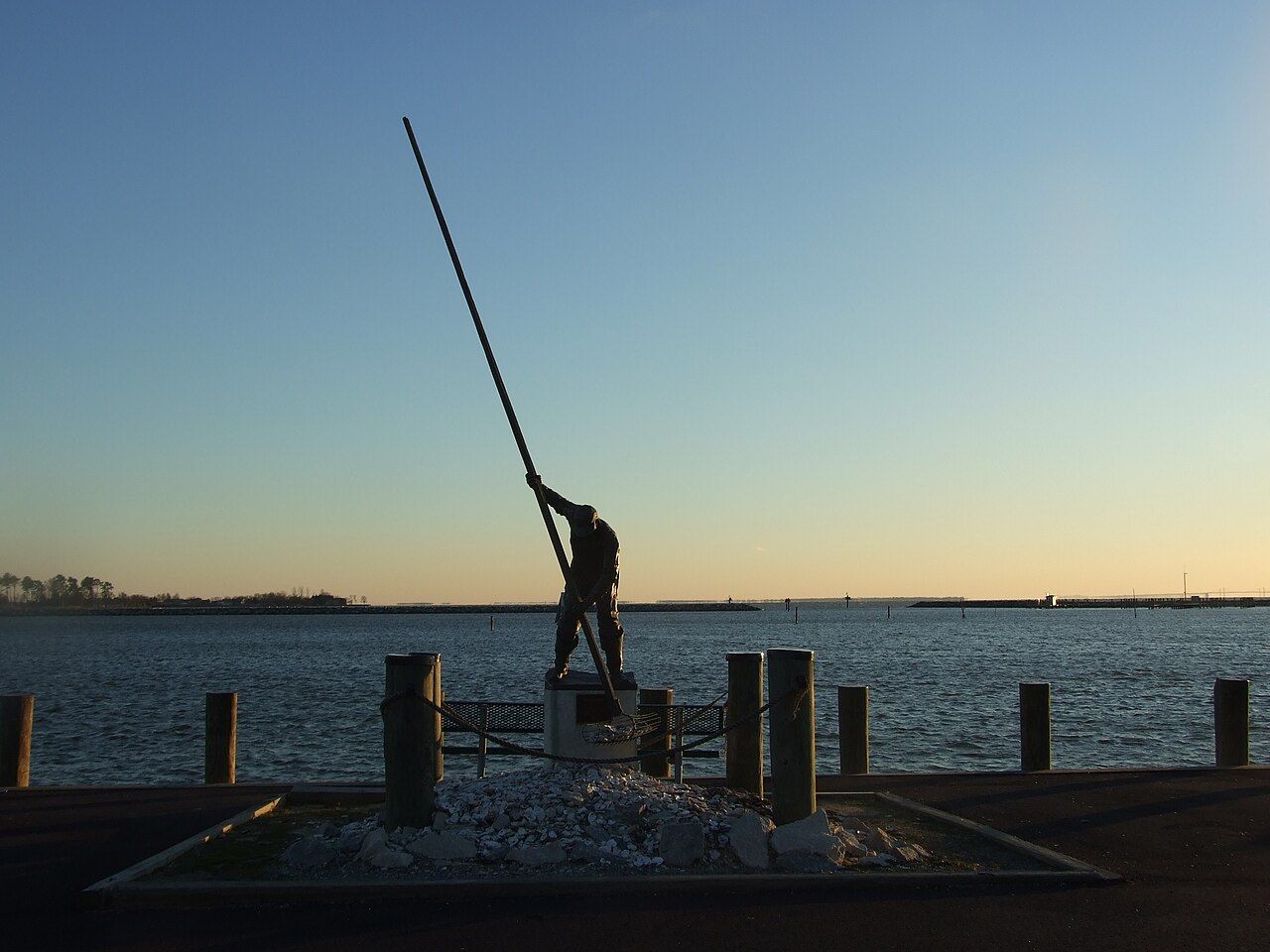
There are two basic ways to bring oysters up from the bottom. Tonging is done from a small boat with a pair of long wooden poles joined like scissors, with rake-like baskets at the bottom. The waterman feels his way along the reef, closes the tongs, and hauls the load up hand over hand. It is slow, skilled and exhausting, and in the shallower rivers it is still done much as it was a century ago. Patent tongs, worked with a winch, came later for deeper water.
Dredging means dragging a heavy toothed iron frame with a chain bag across the bottom behind a boat. For generations, Maryland law kept dredging on most public grounds under sail, to limit the pressure on the reefs. That rule produced the skipjack, a broad, shallow wooden sailboat with a single raked mast and a huge mainsail, built to drag dredges across the oyster beds in the winter wind. Hundreds of skipjacks once worked the bay. Today only a small number survive, and most are kept up as historic vessels, sailing for education and in races rather than for a living. The fleet's home waters are around Tilghman Island and Knapps Narrows, and on Deal Island farther south.
The collapse
By the early twentieth century, decades of heavy harvest had already worn the reefs down, and much of the shell the young oysters needed to settle on had been carried away. Then, in the second half of the century, two parasitic diseases, MSX and Dermo, spread through the bay and killed oysters in huge numbers. Sediment and nutrient pollution from farms, towns and septic systems clouded the water and fed low-oxygen dead zones in summer. By the late twentieth century, the bay's oyster population had fallen to a small fraction of its historic size.
The consequences went beyond the harvest. Without healthy reefs, the bay lost much of its natural filter, and the water grew murkier. Packing houses closed, and towns that had lived by oysters shifted to crabbing, tourism or commuting. On Smith Island and Tilghman, families still work the water, but with fewer boats and fewer young people following their parents onto the bay.
Also enteredSmith Island, far out in the bayBringing the reefs back
Restoration in Maryland now works on several fronts at once. Large areas of the bay have been set aside as oyster sanctuaries, where harvest is not allowed. In several Eastern Shore tributaries, including Harris Creek in Talbot County and the Little Choptank and Tred Avon rivers, state and federal agencies have rebuilt reefs on a large scale, laying down stone or shell and planting them with young oysters raised in hatcheries. The results there have been encouraging, with reefs that hold oysters year after year.
Shell is the limiting resource. Young oysters, called spat, need hard surfaces to settle on, and there is not nearly enough old shell to go around. Shell recycling programs collect oyster shells from kitchens and events so they can go back into the water, and you will sometimes see collection bins at public places around the Shore.
Oyster farming has grown alongside the restoration work. Growers lease areas of bay bottom or water column and raise oysters in cages, floats or on prepared bottom. Farmed oysters are sold year-round and often under the name of the creek where they grew, much the way wine carries the name of a place. For many Eastern Shore watermen, aquaculture has become a way to keep working the water.
The season and the table
The old advice to eat oysters only in months with an R in the name has a basis: the wild public fishery in Maryland is a cold-weather fishery, generally running from autumn into early spring, and oysters taste best in cold water, when they are fat and firm. Farmed oysters have loosened the calendar, but many people on the Shore still think of oysters as a winter food.
Raw on the half shell, the bay's oysters are milder and less salty than ocean oysters, and their flavor shifts from creek to creek with the saltiness of the water. Fried, stewed in milk and butter, or baked into a stuffing at holiday meals, they turn up all winter in Shore kitchens. If you shuck your own, use a proper oyster knife, a folded towel and a heavy glove on the hand holding the shell: the knife slips more often than anyone admits.
To see the boats and tools up close, visit the maritime museum in St. Michaels, where the oystering exhibits and the working boatyard tell the story better than any book. And in summer, when the oyster boats are quiet, the same harbors turn to the bay's other harvest, the blue crab.